
Search Cabarrus Voter Registration
The NCSBE Voter Search is the direct public lookup for a Cabarrus County registration. Start with the name as it likely appears on the registration. First and last names are the only name fields required, while a middle initial, birth year, and Cabarrus County filter can narrow common-name results. At least one voter-status box must remain checked. JavaScript must be enabled for the search to run.
This is a person-by-person lookup, not a proof-of-identity service. A matching profile should be checked against the county, status, and districts before drawing a conclusion. The exact fields available at the search screen are:
| Search field | Input | Required | How to use it |
|---|---|---|---|
| First Name | Text | Yes | Match the spelling used for registration. |
| Middle Initial | Text | No | Add it to reduce same-name results. |
| Last Name | Text | Yes | Enter the registered surname. |
| Year of Birth | Dropdown | No | Uses the year only, not a full birth date. |
| County | Dropdown | No | Select Cabarrus or leave the search statewide. |
| Voter Status | Checkboxes | Yes | Choose Registered, Removed or Denied, or both groups. |
The official Cabarrus voter lookup screen shows these name, county, birth-year, and status controls before a profile opens.
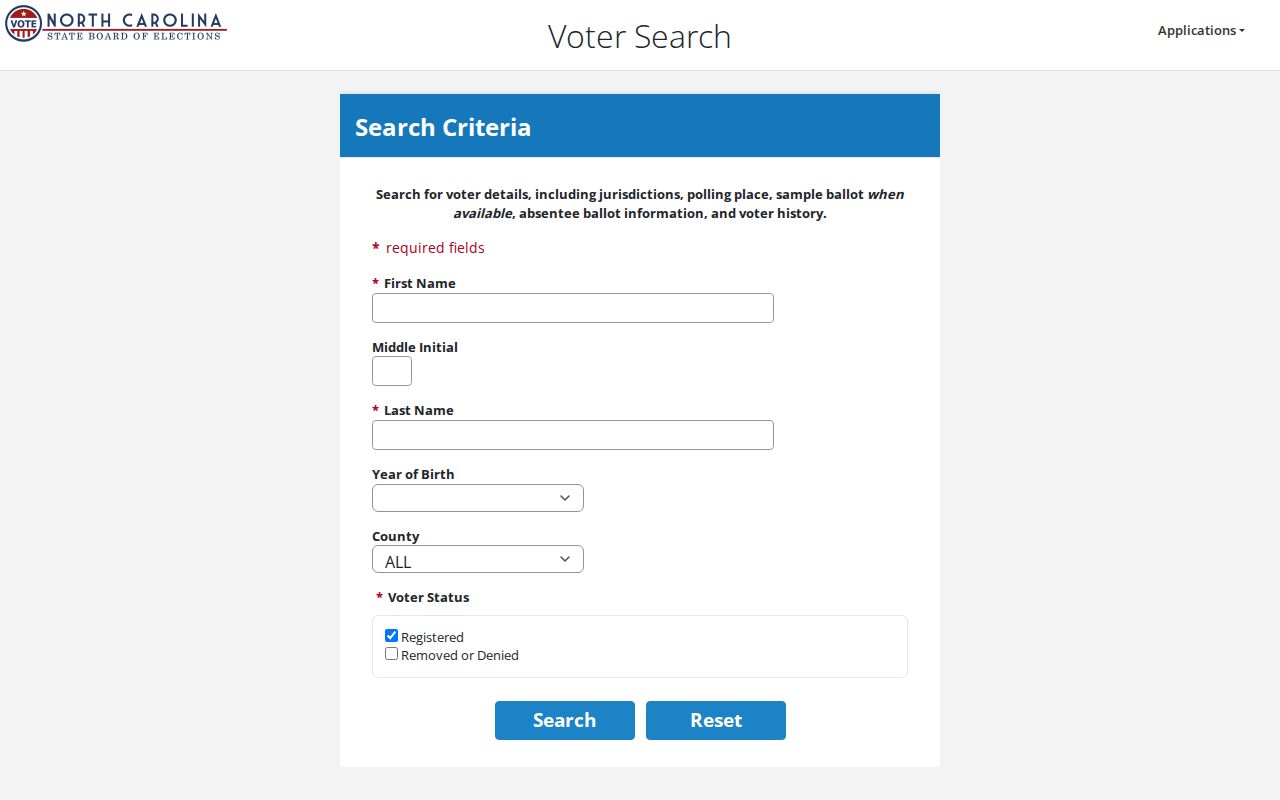
The screen confirms why a county filter and optional year can matter when several North Carolina voters share a name. If a person cannot be resolved online, the Cabarrus County Board of Elections can check the local record or explain its current status.
Inside a Cabarrus Voter Record
A public North Carolina profile is split into six parts. Voter Details identifies the registration. Jurisdictions shows the precinct and the federal, state, court, county, municipal, school, and other districts tied to the address. Voting Locations gives the next polling site and an early-voting route. Separate areas present a suitable sample ballot, mail or early-voting status, and participation history.
The State Board of Elections profile explanation is the best key for reading those sections. The main result fields include:
| Registration details | County, status, voter registration number, NCID, party, registration date, and NCDMV-customer indicator. |
|---|---|
| Demographics | Race, ethnicity, gender, and birth year where publicly released. |
| Assigned areas | Precinct plus legislative, judicial, commissioner, municipal, school, and other applicable districts. |
| Voting locations | Upcoming polling place, its address, county board information, and an early-voting link. |
| Ballot services | Sample ballot and the status, type, method, and return details of mail or early voting. |
| Participation history | Election, voting method, county, and primary ballot type, never marked ballot choices. |
Participation history means that a voter took part in an election. It does not disclose a candidate choice, referendum answer, or any other mark made on a ballot. A sample ballot is only the ballot style that applies to the registration and primary rules.
Cabarrus Voter Records Privacy
North Carolina makes many voter-list fields public, but the line is not all-or-nothing. N.C.G.S. §163-82.10 controls voter-list disclosure. Public categories can include name, address, party, demographic data, registration date, precinct, districts, and elections in which the person participated. The same law protects sensitive source data and certain records tied to personal safety.
Confidential under North Carolina law. Social Security numbers, full dates of birth, driver-license numbers, identity-document copies, certain registration-agency details, military or overseas email addresses, captured signature images, and court-ordered or program-protected addresses are not released as ordinary voter data. A signature may be viewed for authorized purposes but may not be copied or traced except for election administration.
The public data file may carry yes-or-no flags showing that an ID, driver-license, Social Security, or federal HAVA requirement was addressed. Those markers do not reveal the underlying number. Ballot selections remain secret regardless of whether a profile, history row, or downloadable file is used.
Read Cabarrus Voter Roll Status
Status codes need context. The public file uses A for active, D for denied, I for inactive, R for removed, and S for a temporary military or overseas record. Inactive does not mean that the registration was instantly cancelled. County boards maintain rolls for deaths, felony convictions, moves, and a lack of voter contact, while federal confirmation and waiting safeguards apply.
A removed or denied result deserves a current check with the local board, especially when an election is near. File masks such as # or xx/xx/xxxx may signal county review rather than a fact about the voter. The reason code and description should be read with the status, not treated as a stand-alone label.
Note: Online status is useful for research, but the Cabarrus elections office is the source for correcting or confirming a registration.
Download Cabarrus Voter Data Free
Myth: North Carolina’s ordinary public voter file is not a paid, restricted product. The NCSBE voter registration data page publishes statewide and county ZIP files without a request form or fee. Files are tab-delimited, so a spreadsheet or database can sort rows after extraction. They refresh weekly on Sunday evening, and Cabarrus County is identified by county ID 13.
- Open the state registration-data page and choose the Cabarrus County ZIP for a local file or the statewide ZIP for broader work.
- Download and extract the text file. Import it as tab-delimited data so each public field stays in its own column.
- Filter the county description or county ID, then use names, status, precinct, registration date, or districts to answer the research question.
- Check the page’s update date and save it with the file. A later weekly release may reflect a move, status change, or correction.
The official voter-file download screen distinguishes current and historical file choices and explains the published data.
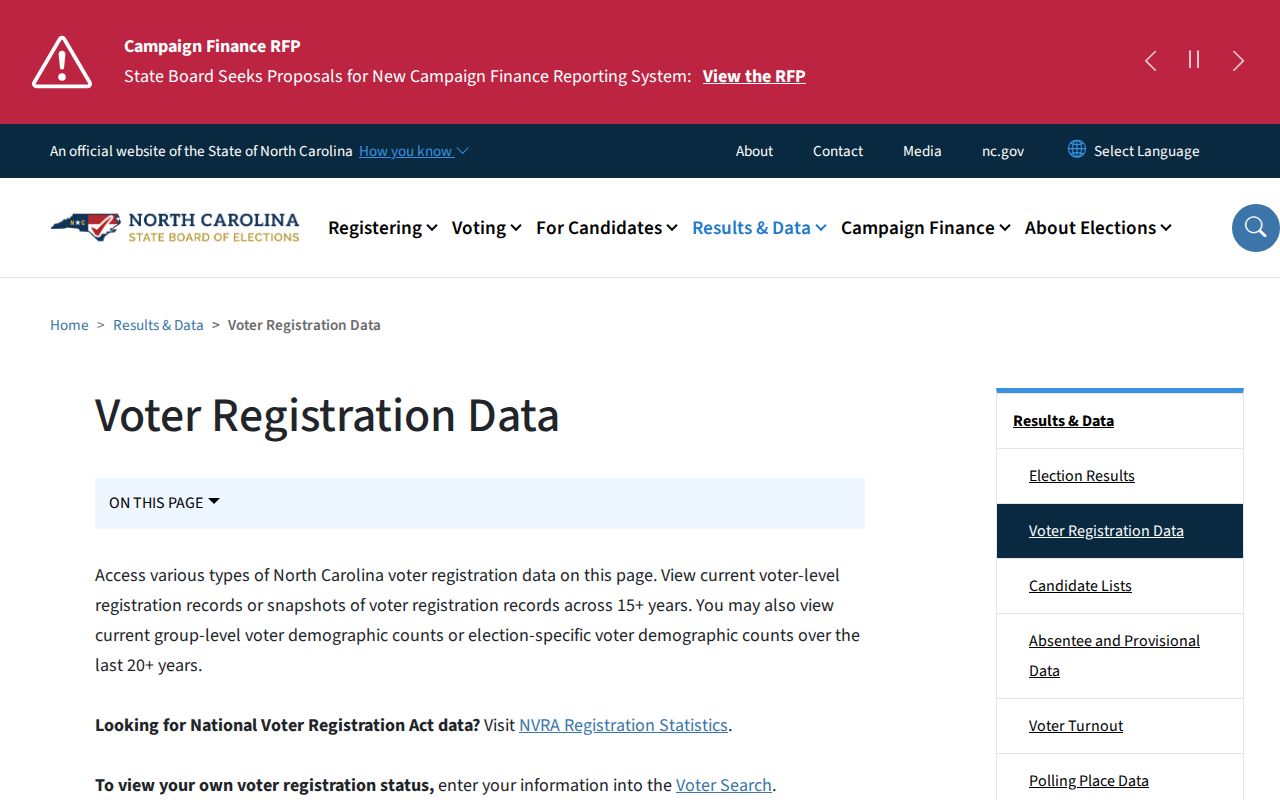
The download page confirms that ordinary access begins with a free file, not a paid application. Current releases can include registered, formerly registered, and attempted or incomplete registrations. Removed voters leave the published data when their most recent last-voted date is more than ten years old.
Track Cabarrus Voter History
The NCSBE voter-history files cover participation in the past ten years and update weekly. Each row can include the registration number, NCID, party, county, precinct, election, and voting method. Names and demographics are joined through the registration file. Registration snapshots reach back more than fifteen years, while grouped statistics and election datasets extend beyond twenty years.
Insider tip: A Cabarrus County history file follows people who are currently registered in Cabarrus. That is not always the same group that voted in Cabarrus during an older election. For a historically sound participation count, use the statewide history file and filter the voted_county_desc field for Cabarrus.
This distinction matters when people move across county lines. It also keeps the history from being misread as a record of vote choices. The file shows that an election was attended and the voting method used. It cannot reveal how the ballot was marked.
Cabarrus Voter Records Access Channels
Three current channels cover different needs. Use the NCSBE name lookup for one profile. Use the free state or county file for a large set of public rows. For a selective list that those tools cannot produce, contact the Cabarrus County Board of Elections under §163-82.10. No Cabarrus-specific custom-list form or posted fee was found, so ask the office about scope, format, and any cost before relying on that route.
Cabarrus Board of Elections
Director: Carol Soles
Address: 369 Church St. N., Concord, NC 28025
Phone: 704-920-2860
Fax: 704-920-2831
Email: elections@cabarruscounty.us
Hours: Monday through Friday, 8 a.m. to 5 p.m.
Phone, email, and an office visit are practical fallbacks when the online search cannot distinguish two records or when a status needs explanation. General public-record rules are handled separately in the Cabarrus County public records system; election-list disclosure has its more specific rules in Chapter 163.
Protect Cabarrus Voter Addresses
Some voters face a real safety risk if a residence address is exposed. North Carolina’s Address Confidentiality Program, administered by the Attorney General under Chapter 15C, can provide a substitute address and keep a participant’s residence confidential while certification remains active.
An eligible participant presents the program card and safety statement when dealing with the elections office. A court order can also support address suppression in the voter record. The public lookup and bulk file should not be used to defeat either safeguard. Program questions go to acp@ncdoj.gov or 919-716-6785.
Note: A missing residence address may reflect a legal protection, not a broken profile or incomplete voter registration record.
Use Cabarrus Voter Records Lawfully
Public access is not consent to monitor, threaten, impersonate, or harass a person. North Carolina stalking law, N.C.G.S. §14-277.3A, and cyberstalking law, §14-196.3, may apply when public data is used for prohibited repeated following, monitoring, threats, or electronic harassment. Chapter 163 restrictions and other civil or criminal laws still govern election data after it is downloaded.
Keep the purpose lawful. Use Cabarrus voter rolls for civic research, genealogy, district checks, or election analysis. Never use an address, phone number, or participation history to stalk, intimidate, expose a protected person, or interfere with voting.
A profile is also not proof of identity. Match county, registration date, status, and districts before linking a row to a person. When a high-impact question depends on the answer, verify it with the Board of Elections rather than trusting a same-name result.
Historical Cabarrus Election Records
Digital history has limits. The weekly participation file reaches back ten years, and saved registration snapshots go farther, but neither replaces old poll books or election registers. Historical election material appears among the State Archives Cabarrus County records. The top-level guide does not publish exact local poll-book or register years.
Begin with the statewide archive guide, then ask staff to identify the series, election date, precinct, and format that may survive. The Cabarrus Board of Elections is the current-record fallback, while the State Archives is the stronger route for transferred historical material. Give a person’s full name, approximate election year, and known precinct or community when possible.
A gap in the online profile does not prove that no older record exists. It may mean the relevant evidence is in a paper volume, microfilm series, or archival box that has not been indexed at the person level.