
Which Cabarrus Records Are Open
North Carolina law starts with a broad rule. A record made or received in public business is open unless another law protects it. The result is not one all-purpose database. Cabarrus County deeds, tax rolls, court dockets, certificates, custody data, and archived files each have a distinct custodian and access route. An online index is often open even when the full image or certified copy requires a visit, identity proof, or a fee.
| Record Set | Custodian | Online Index | Access |
|---|---|---|---|
| Deeds, trusts, liens, plats | Register of Deeds | CLaRIS and county indexes | Public after recording; web copies are unofficial |
| Property, tax, and GIS | Tax Administration and GIS | Real Estate Search and Map Cabarrus | Free informational access |
| Civil, criminal, and estates | Clerk of Superior Court | NC eCourts Portal | Public unless sealed or otherwise confidential |
| Birth, death, marriage | Register of Deeds and NC Vital Records | Ordering services; historical indexes vary | Certified-copy eligibility is restricted |
| Jail and correction records | Sheriff, NC DAC, and SBI | Separate official lookups | Published data has statutory limits |
| Archived county series | State Archives | County guide and catalog | Series-level search; many originals require reading-room access |
Important limits remain. Sealed and expunged cases, juvenile and adoption files, confidential personnel and medical data, Social Security and financial identifiers, protected addresses, and some active investigative material are not made open by a name search. Military discharges recorded for less than 80 years have restricted access under the Register’s published rule. DMV personal data is also restricted by federal and state law.
Cabarrus Deed Index Access
The CLaRIS land-record system is a finding aid for deeds, deeds of trust, liens, plats, and related instruments. It warns that online material may contain errors or omissions and is not a legal document. The official record stays with the Register of Deeds. Search married names, initials, both sides of a transfer, and business-name variants. A known book and page is usually the cleanest route to a specific instrument.
| Field or Mode | Type | Required | Options and Format |
|---|---|---|---|
| Search mode | Tab or link | One mode | Choose a property, parcel, or recorded-document path |
| Owner or name | Text | Conditional | Try surname variants and entity names with and without punctuation |
| Parcel or PIN | Text | Conditional | Use the identifier from the tax or GIS record |
| Address | Text or components | Conditional | Normalize direction and street suffix; retry without a unit |
| Book/page or instrument | Text | Conditional | Use a known recorded citation for the most direct result |
| Search or reset | Buttons | No | Run the criteria or clear the form |
The county library describes deed transactions from 1791 to the present, an unusually long name trail. It does not publish a firm first year for every online image. The vendor endpoint was under maintenance during research, so remote access should be checked before relying on it. Call the Register at 704-920-2112 or use the counter when an image is absent.
- Index
- A list of names and document references used to locate the official instrument.
- Certified copy
- An office-issued copy authenticated for formal use.
- Custodian
- The office legally responsible for keeping and producing a record.
- Exemption
- A law that protects all or part of an otherwise public file.
Search Cabarrus Property Records
The Cabarrus Real Estate Search accepts owner surname and given name, account number, parcel components, tax year, and a structured address. Advanced fields include land-size range, land type, and zoning. At least one field is required. Years through 2016 were selectable during inspection, but the current default may change with each tax cycle.
A parcel card can show owner and mailing names, the situs address, account and PIN, legal description, assessed values, sales, improvements, and deed book and page. Situs means where the land sits. A mailing address is where the tax notice goes, so it does not prove that the owner lives on the parcel. The county GIS viewer adds jurisdiction, zoning, flood, school, service, and aerial context, including historical aerials reaching 1938. Only a recorded instrument proves a transfer.
Postal labels can mislead. Cabarrus contains seven zoning and permit jurisdictions, and a Concord mailing address does not always identify the right government office. Check the parcel’s municipality and jurisdiction fields before seeking a permit or local administrative file.
Note: Tax Administration answers data questions at 704-920-2126; GIS handles map questions at 704-920-2487.
Cabarrus Records Enter eCourts
Cabarrus County moved to Enterprise Justice and the North Carolina eCourts Portal on October 14, 2024. Search controls can include a person or business name, case number, county, case category, and filing dates. Select Cabarrus when a common name produces results from across the state. A docket may list the case number, court, parties, filing date, status, attorneys, charges or claims, hearings, and public dispositions.
The conversion is a recent access milestone, but it did not put every document online. Converted legacy events may appear without a published earliest Cabarrus case year. Public courthouse terminals can expose docket detail or images that remote access omits. Write down the case number and ask the Clerk of Superior Court for a plain or certified copy.
Court records belong to the clerk, not Cabarrus County administration. Estates and probated wills are also court files because the Clerk of Superior Court serves as judge of probate. A county JustFOIA request is therefore the wrong route for an individual case. Federal matters use the Western District of North Carolina and PACER instead.
Cabarrus Vital Records Boundaries
Birth, death, and marriage certificates are not ordinary open-inspection records. N.C.G.S. §130A-93 controls access, and certified copies depend on the requester’s relationship or legal authority rather than a simple number of closed years. The Cabarrus Register of Deeds issues county-filed certificates and qualifying statewide birth abstracts for births from 1971 forward. North Carolina Vital Records handles broader statewide services and divorce certificates.
Local marriage records begin with county formation in 1792. Bonds from 1792 through 1855 are at the State Archives, with indexes at the Register, while originals from 1856 forward remain local. State birth and death registration began in late 1913. For mail orders, the county form requires a valid photo ID, relationship or legal-right selection, a self-addressed stamped envelope, and check or money order. Send it to P.O. Box 707, Concord, NC 28026-0707.
A historical name and date in an index is not the same as a certified certificate. For older family research, use archive series, church material, cemetery evidence, and newspapers, then tie the reference back to the original register or book.
Cabarrus Custody and Registry Records
Custody and offender information is split among agencies. The Cabarrus Sheriff inmate inquiry reports current or recent jail status. The North Carolina Department of Adult Correction search covers state correctional custody and supervision. The SBI registry uses name, address, and map searches under its own statutory rules. A booking or registry result is not a court disposition, and a jail record does not prove guilt. Use the case number to verify the court docket.
The official North Carolina Sex Offender and Public Protection Registry shows the available search modes and legal warnings:
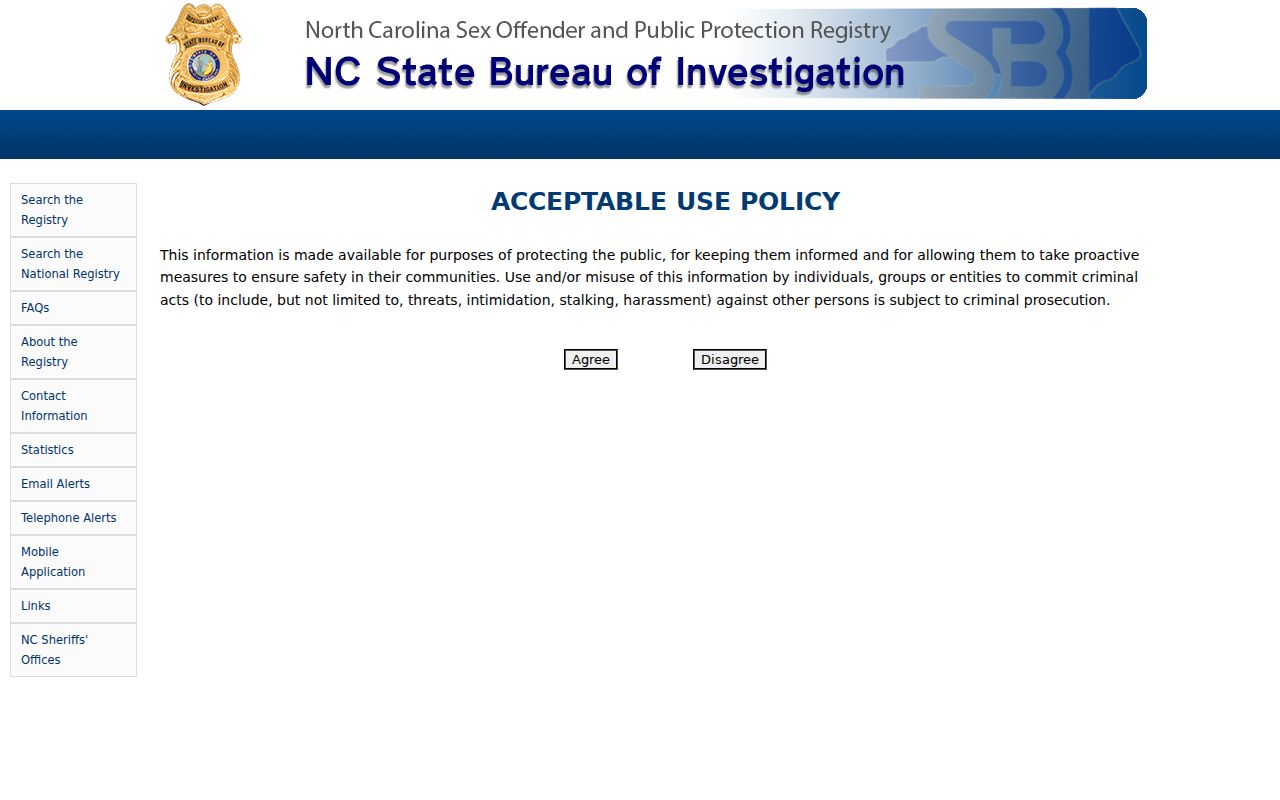
The interface helps distinguish name, address, and location-based queries before a result is opened. Use published records only for lawful personal safety and source verification.
Incident and crash reports follow the agency that made them. Cabarrus Sheriff, Concord Police, Kannapolis Police, and other municipal departments keep their own files. Give the incident number, date, place, people involved, and exact document requested. Public arrest basics may be separated from protected victim, juvenile, medical, or active investigative detail.
Cabarrus Records in NCCash
Not all useful state records are kept by a county office. NCCash, run by the North Carolina Department of State Treasurer, searches unclaimed property by owner or organization name and location. Results may show the reported city, reporting business, property type, and a claim route. The search and claim start are free. Proof of identity and ownership is required before funds are released.
The official NCCash entry screen keeps the public name search separate from the later proof process:
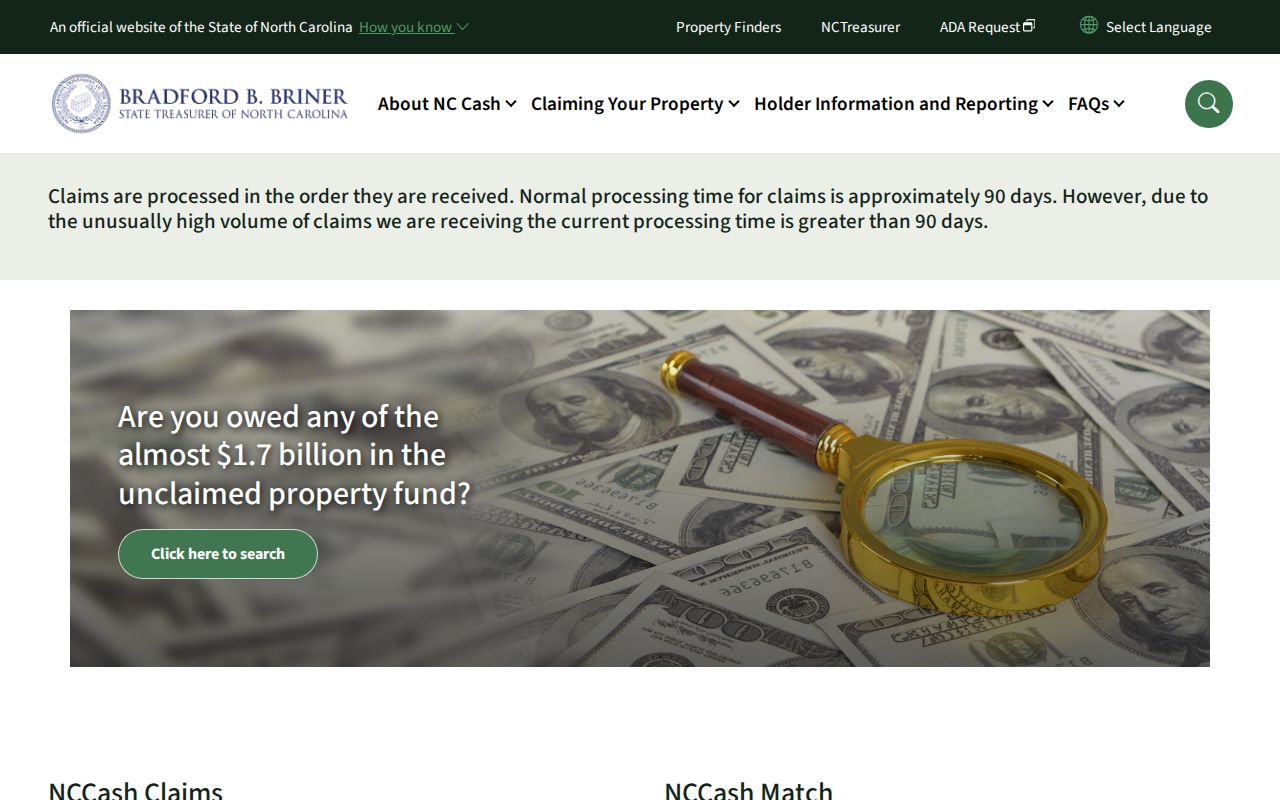
A match can connect a person, heir, or old business to a reported address, but it is not proof of a current location. Avoid solicitations that demand an up-front fee for a search the state provides at no charge.
Cabarrus Public Records Custodians
Three Concord offices handle most local requests, but they do not substitute for one another. The Register keeps recorded instruments and local certificates. Tax Administration maintains the assessment roll. The Clerk of Superior Court keeps court and probate files. Confirm the custodian before sending money or personal documents.
Cabarrus County Register of Deeds
65 Church St. S.
Concord, NC 28025
704-920-2112
The Register publishes weekday public hours of 8 a.m. to 5 p.m., with recording accepted through 4:30 p.m. Staff cannot draft instruments, supply legal forms, or advise on legal consequences. Call ahead when an older volume, archived case, or certified copy may need staff retrieval.
Cabarrus Records Beyond the Web
Older or missing material may continue at the counter, courthouse terminal, county library, or State Archives. The Cabarrus County archives guide describes court, estate, land, marriage, tax, will, and miscellaneous series. The estates index spans 1793 through 1953. Miscellaneous records from 1794 through 1945 include coroners’ inquests, jury lists, exemptions, and evidence involving mills and telephone companies.
The first surviving digitized Court of Pleas and Quarter Sessions minutes cover 1793 through 1797. The courthouse fire of 1876 did not erase the county trail wholesale. The official county history says only a few court records were lost. Deeds, marriages, and many court and estate series survive. If one file is absent, ask about alternate indexes, transferred series, or retention before assuming the fire destroyed it.
Note: An archive catalog describes holdings; it does not mean every named page is remotely viewable.
Cabarrus Records Copy Costs
Chapter 132 usually permits the actual cost of reproduction, not ordinary search labor. A reasonable special service charge can apply when a request needs extensive technology or clerical work, but it must reflect actual incurred cost. The Register charges $5 for the first page and $2 for each additional page of a certified recorded instrument under N.C.G.S. §161-10. Local certified vital copies are $10, and mailed uncertified county copies are $1 per page.
Recording charges follow a separate fee schedule. The Register accepts cash or check for those charges and says credit cards are not accepted. Court copies and certifications follow the Judicial Branch schedule. Archive reproduction and research fees vary. Ask for an estimate when a request is broad, and narrow it by record type, date range, person, address, book and page, case number, or preferred file format.
Protecting Names in Cabarrus Records
North Carolina does not provide one general deletion right for lawfully open deeds, tax rolls, dockets, or voter data. The Register’s public-redaction route applies only where a statute authorizes removal. It cannot erase a name or address merely because its publication is unwelcome. Older recorded images may expose sensitive identifiers, so requesters should avoid copying or sharing data that is not needed.
The Address Confidentiality Program gives qualifying survivors a substitute address and forwarded mail under Chapter 15C. It is prospective protection, not a complete purge of older records. Participants should coordinate with the program and each custodian before filing a document that could reveal a location. North Carolina stalking and cyberstalking laws also restrict threatening, repeated monitoring, and electronic harassment.
The Register’s free Property Notification service can email an alert when a document is recorded under a registered personal or business name. It does not prevent recording, but it can flag activity for prompt review. Use the official signup route rather than a paid imitation.
Request Cabarrus Public Records
Any person may request existing records under Chapter 132. A general request does not require a statement of purpose. N.C.G.S. §132-6 says inspection and copies must be provided as promptly as possible, but it sets no fixed number of days. The agency need not answer questions or create a new compilation. When part of a file is confidential, the custodian should separate protected content when feasible and release the rest.
- Identify the office that created or keeps the record. Court, Sheriff, city, vital, and recorded-document requests use different channels.
- Check the official index first. Save a case number, parcel PIN, instrument citation, incident number, or exact date range.
- For county administrative files, use the Cabarrus JustFOIA portal or visit the County Manager’s Office at 65 Church St. S., Suite 235.
- Describe the record, department, subject, dates, preferred format, and delivery contact. Ask for a cost estimate if the scope is large.
- If access is denied, ask for the legal basis and whether a narrower or redacted release is possible. N.C.G.S. §132-9 permits a civil action to compel disclosure.
Lawful personal use. Open access does not permit stalking, harassment, intimidation, impersonation, or disclosure of protected information. Verify each name against the official record before acting on it.
In-person county requests may also begin at the County Manager’s Office, 704-920-2100. Send a court request to the Clerk, an incident report request to the Sheriff or creating police agency, and a deed or certificate request to the Register. Correct routing prevents delay and avoids sending identity documents to an office that does not need them.